The draw for the 2026 World Cup, jointly hosted by the United States, Canada, and Mexico, was held at the Kennedy Center for the Performing Arts in Washington, D.C. A surprise appearance by Donald Trump caused the ceremony to be repeatedly delayed, and the final draw was not confirmed until after 3 p.m.
Although six berths will not be decided until March next year, the combination of tournament expansion and extensive confederation-avoidance rules has resulted in something unprecedented: not a single “Group of Death.” Especially under the new group-stage rules—where only 16 teams are eliminated—the danger presented by some seemingly tricky groups is far lower than it appears.
For the favorites, however, finishing top of their groups will vary in difficulty. Meanwhile, for four debuting teams and several potential dark horses, opportunity may be closer than ever.
Spain remain one of the favorites to win the title.
FOUR FAVORITES — WITH FRANCE DRAWING THE SHORTEST STRAW
This World Cup draw adopted a system similar to Grand Slam tennis tournaments: the “Big Four” are kept apart. The current top four in the FIFA World Ranking—Spain, Argentina, France, and England—were allocated to different halves of the bracket, ensuring they cannot meet each other before the semifinals, provided they all win their groups.
These four national teams are also the biggest commercial attractions. At the 1994 World Cup, Germany’s shock elimination in the quarterfinals led to a sharp decline in ticket and merchandising sales. Learning from that, this year’s draw almost feels like an escort service for the tournament’s top contenders.
Argentina, the defending champion, enjoyed one of the best draws ever awarded to a titleholder. Jordan are complete newcomers, while Austria (last in 1998) and Algeria (last in 2014) have been absent from the tournament for years. Compared with Argentina—virtually a World Cup regular—the experience gap is enormous.
In fact, the draw mirrors the Albiceleste’s 2014 group: one European newcomer, one African side, and one Asian team. And this trio appears even weaker than Bosnia, Nigeria, and Iran were at the time. Back then, Argentina won all three group matches and marched all the way to the final. Today, aside from the unpredictable high-pressing Austrian side under Ralf Rangnick, the group presents few threats.
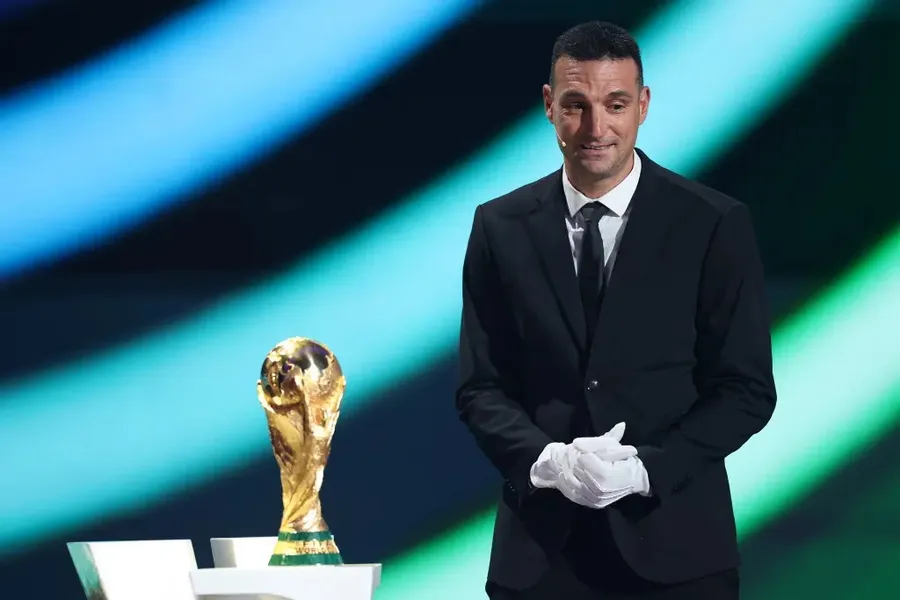
Argentina head coach Lionel Scaloni at the draw ceremony.
Argentina also have an underrated advantage: familiarity with U.S. venues and conditions. Messi, De Paul, and Almada all play in MLS, and Argentina have chosen U.S. stadiums for many friendly matches. They also competed in the 2016 and 2024 Copa America tournaments hosted in the U.S. Calling it “half a home World Cup” is no exaggeration.
Spain and England also received favorable draws—standard “one giant plus two minnows” groups reminiscent of the 32-team era. But both will have to stay sharp: Uruguay and Croatia are weaker than in past cycles but still dangerous.
Uruguay have struggled in World Cup qualifying and haven’t reached a Copa América semifinal in years. Croatia—third in Qatar—look exhausted and were eliminated in the group stage at the last European Championship.
The schedule is worth noting: Spain face Uruguay in the final group match, and the Spanish are notorious for late-group complacency. England open against Croatia, and after a long Premier League season, the players' early-tournament condition is uncertain.
France manager Didier Deschamps faces the toughest road.
Of the four big favorites, France clearly drew the most difficult group. They face both a strong Africa champion contender (Senegal) and a golden-generation Norway featuring Haaland and Ødegaard. The opener against Senegal brings back memories of 2002, when a Diop goal eliminated the reigning champions in the group stage and began the infamous “next-edition curse.”
The group finale—France vs. Norway—will also be Mbappé versus Haaland in their first ever meeting at a major international tournament. Great for fans, tough for Deschamps.
Norway’s qualification form was superb; if not for years of underperformance accumulating in FIFA ranking points, they would never be placed in Pot 4.
This is not the ideal beginning for a team that traditionally starts World Cups slowly and is coming off a runner-up finish.
Carlo Ancelotti will lead Brazil into the tournament.
NOSTALGIA TAKES CENTER STAGE
After the top seeds were placed, several groups recreated classic matchups from previous World Cups.
Brazil’s Group C is almost a perfect replica of Group A in 1998, where the Seleção met Scotland and Morocco. Back then, Brazil won both matches (2–1 and 3–0). The only difference in 2026 is Haiti replacing Norway.
Yet those earlier matchups produced unforgettable moments—from Scotland’s late own goal to Mustapha Hadji’s spectacular solo runs. Today, McTominay and Achraf Hakimi inherit that legacy, facing a Brazilian side that has struggled for form in recent years.
Germany’s Group E brings them back to a familiar opponent: Ecuador. In 2006, the Germans defeated Ecuador 3–0 to top the group and spark public confidence in Jürgen Klinsmann’s project. This time the two sides meet again in the final group match.
Ecuador today, however, are far more defense-oriented, while Germany’s inconsistency under Julian Nagelsmann makes this a potentially tricky group.
Even more concerning is the presence of Ivory Coast—historically trapped in “Groups of Death”:
• 2006: Argentina, Netherlands, Serbia
• 2010: Brazil, Portugal, North Korea
• 2014: Japan, Greece, Colombia
If this pattern continues, Germany must tread carefully.
Germany enter the tournament with uncertainty.
The Dutch in Group F also meet familiar faces. Japan famously pushed them hard in 2010 before Wesley Sneijder decided the match. And if Sweden, Ukraine, or Poland qualify from the European playoffs, the Japanese and Dutch will again see old foes.
Belgium, the “invisible winners” of almost every draw, once again received an extremely favorable group: Egypt, Iran, and New Zealand—all among the weaker sides in their respective pots.
Portugal in Group K received a similarly gentle landing. Colombia are strong but face Portugal last, when qualification may already be settled. The playoff winner (likely DR Congo or Jamaica) and debutants Uzbekistan are unlikely to trouble a Portugal squad packed with quality. It may even offer Cristiano Ronaldo one more chance to pad his international goal tally.
Curaçao have reached the World Cup for the first time.
NEWCOMERS READY TO FIGHT — WHILE ITALY WAITS AT THE GATES
Expansion to 48 teams resulted in only four debutants, a sign of how difficult it remains for outsiders to break into the World Cup. Curaçao, Cape Verde, Jordan, and Uzbekistan all face brutal challenges.
Curaçao—ranked lowest of the four—landed in Germany’s Group E along with Ivory Coast and Ecuador. Their realistic goal may simply be avoiding last place overall.
Cape Verde, drawn with Spain in Group H along with Uruguay and Saudi Arabia, face a similar uphill battle. Saudi Arabia—shaky in qualifying—may be their main opportunity to grab points.
Jordan, ranked 66th, will share a group with Argentina. Their best hope may be to imitate Saudi Arabia in 2022 and chase a historic upset.
Uzbekistan—ranked 50th—face Portugal, Colombia, and the intercontinental playoff winner. They cannot reasonably target the giants, but under the 48-team system, even two points might theoretically be enough to progress as a third-place side.
And then comes the team everyone is watching: Italy.
Italy still must fight for their ticket.
Should Gattuso’s Italy escape the European playoff path—considered the easiest bracket—they will join Group B as a Pot 4 team alongside hosts Canada, Qatar, and Switzerland.
With Canada and Qatar both far from elite level, and Switzerland a familiar European opponent, Italy would immediately become the favorite to win the group.
In other words: despite not yet qualifying, Italy might be the real hidden winner of this draw.